
Are you still struggling with pelvic pain — searching for answers but not finding any that actually fit? You’re not making this up. Your pain is real. It’s just misunderstood.
What Is Chronic Pelvic Pain?
Chronic pelvic pain is, at its simplest, pain in the pelvic region that has lasted longer than three months. It doesn’t require a specific diagnosis to be real, and it doesn’t have to look the same in every person. As described in Pelvic Pain Explained by Stephanie Prendergast and Elizabeth Rummer, chronic pelvic pain is one of the most complex and underserved conditions in healthcare — affecting people of all genders, often for years before they find the right help.
Two Categories Worth Understanding
Knowing where to start with pelvic pain can feel overwhelming — especially if you’ve already sought care and been told your tests are clear, there’s no obvious reason for the pain, or simply been handed a prescription and sent on your way. That experience is incredibly common, and incredibly frustrating.
To help make sense of it, it’s useful to think about chronic pelvic pain in two broad categories — because where your pain lives within those categories shapes so much about how it is approached and treated.
Category 1: “No Root Cause Found” — But Your Pain Is Real
If you’ve been told there’s no cause for your pain, or that everything looks normal, please hear this: you are not making it up. Pain is always real. What “no root cause found” usually means is that the right cause hasn’t been identified yet — not that one doesn’t exist.
Chronic pelvic pain is complex. For many people, the root cause simply hasn’t been found or properly treated yet. The conditions listed below are frequently missed, misdiagnosed, or dismissed entirely — and each one has a very real, very treatable physical basis. For others, the original trigger may have resolved, but the pain system has stayed switched on. This is called central sensitization — where the nervous system becomes overprotective, continuing to generate pain signals even without ongoing tissue damage. This isn’t weakness. It’s biology.
Either way, there is a path forward. And it starts with being believed.
Interstitial Cystitis / Bladder Pain Syndrome
Interstitial Cystitis (IC), also called Bladder Pain Syndrome, is one of the most commonly misdiagnosed conditions in pelvic pain. People with IC experience bladder pressure, urgency, frequent urination, and pelvic aching unrelated to infection — many are treated repeatedly for UTIs that never culture positive. The AUA’s 2022 guidelines were written specifically to address the widespread misdiagnosis, underdiagnosis, and undertreatment of IC/BPS — which says a lot about how often people are failed by the system. The pelvic floor muscles almost always become involved, and that’s where pelvic physical therapy makes a real difference.
Interstitial Cystitis Association (Reference: Clemens JQ et al. J Urol. 2022;208(1):34–42)
Vulvodynia / Vestibulodynia
Vulvodynia is chronic vulvar pain with no identifiable cause — it can be constant or provoked by touch, pressure, or penetration. Vestibulodynia is a specific subtype where pain is concentrated at the vaginal opening. Many people with this condition are told their pain is psychological, or are simply given topical creams that don’t address the underlying nerve sensitivity or pelvic floor dysfunction driving the symptoms. It is far more common than most people — and many practitioners — realize.
Pudendal Neuralgia
The pudendal nerve runs through the pelvic floor and supplies sensation to the genitals, perineum, and rectum. When this nerve becomes irritated or compressed, it can cause burning, stabbing, or electric pain in any of these areas — often made worse by sitting. Pudendal neuralgia is frequently missed because the symptoms can mimic so many other conditions, and because awareness of it, even among medical professionals, remains low.
Dyspareunia / Pain with Sex
Pain with sex — whether at entry, deep inside, or after — is not normal and should never be dismissed as something to push through. Dyspareunia can stem from pelvic floor muscle tension, nerve sensitivity, hormonal changes, scar tissue, or a combination of factors. It affects people of all genders and is one of the most underreported pelvic pain symptoms, largely because people feel embarrassed to raise it with their providers.
Rectal Pain / Painful Bowel Movements
Pain with bowel movements, rectal pressure, or a feeling of something sitting in the rectum can all be signs of pelvic floor involvement — not just a gastrointestinal problem. Conditions like levator ani syndrome, proctalgia fugax, and hypertonic pelvic floor dysfunction can all produce these symptoms. Many people spend years cycling through gastroenterology referrals without anyone examining the pelvic floor muscles as a potential source.
Testicular / Penile Pain
Chronic testicular or penile pain with no clear urological cause is more common than research reflects — largely because men are less likely to seek help and the pelvic floor is rarely the first place anyone looks. A survey of 41 men with chronic idiopathic testicular pain found that 93% reported pelvic floor dysfunction symptoms, and 88% showed a hypertonic pelvic floor on electromyographic testing. Pelvic floor physical therapy is an effective, non-operative option that is still significantly underutilized in this population.
Tailbone Pain (Coccydynia)
Coccydynia — pain in or around the tailbone — is often triggered by a fall, prolonged sitting, or childbirth, but it can persist long after the initial injury has healed. The pelvic floor muscles attach directly to the coccyx, meaning tension and dysfunction in the floor can keep this pain going. It is commonly treated with painkillers or injections alone, without addressing the muscular component that pelvic physical therapy is well placed to treat.
Symphysis Pubis Dysfunction (SPD)
SPD involves pain at the pubic joint at the front of the pelvis and is most commonly associated with pregnancy, though it can occur outside of it. The pelvic floor, hip, and abdominal muscles all influence the load placed on this joint, and dysfunction in any of these can contribute to pain, instability, and difficulty with walking, stairs, or lying down. It is often undertreated because it is assumed to resolve on its own after pregnancy — which is not always the case.
Vaginismus
Vaginismus is an involuntary contraction of the pelvic floor muscles that makes penetration — whether for sex, tampon use, or gynecological examination — painful or impossible. It is not a psychological weakness or a choice. It is a neuromuscular response, often rooted in pain anticipation, previous trauma, or learned protective patterns. Research supports pelvic physical therapy as a highly effective treatment, with outcomes strongest when combined with psychological support — a good reminder that the most effective care for vaginismus addresses both the body and the nervous system together.
Prolapse & Pain
Pelvic organ prolapse occurs when one or more of the pelvic organs descend due to weakened support structures. While prolapse is not always painful, it can cause pressure, heaviness, and dragging sensations that significantly impact quality of life. It’s worth knowing that vaginal wall laxity — rather than true organ descent — is often what’s driving these symptoms, and this responds very well to pelvic physical therapy. Treatment focuses on improving support, managing symptoms, and helping people return to activities they’ve been avoiding.
Abdominal Wall Referral Pain
Pain that appears to come from inside the pelvis or abdomen is sometimes actually originating from trigger points or nerve entrapments in the abdominal wall itself. This is frequently overlooked because the referral pattern can mimic bladder, bowel, or reproductive pain convincingly. A thorough assessment that includes the abdominal wall is essential — and for many people, treating this source of referred pain produces significant relief.
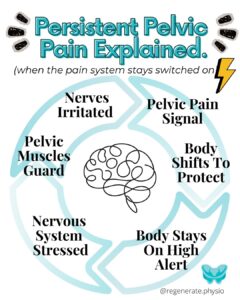
Category 2: Persistent Pain — When the Brain Adapts
Your brain interprets signals from your body and makes a decision — and pain is the output of that decision. In the early stages, this is protective. It makes sense. But after a while, even when the original injury has healed, the nervous system can begin to recognize almost any stimulus as a potential threat. Touch, movement, stress, even anticipation — the brain flags it all as danger and responds accordingly, sometimes with a full sympathetic nervous system response, sometimes with pain itself.
This isn’t your nervous system being broken. It’s an adaptation. The brain and nervous system have learned, over time, to protect you — and that learning doesn’t automatically switch off when the tissue heals. Understanding this is important, because it changes how we approach treatment. We’re not just treating a body part. We’re working with a nervous system that has become highly protective — and that can be retrained.
You Have Choices in Your Care
Chronic pelvic pain is complex — but it is not a dead end. Whether you are still searching for a root cause or stuck in a persistent pain loop, there are approaches that go beyond a prescription and a referral. Care that listens to your whole story, that looks at the body and the nervous system together, and that works toward lasting relief — not just management.
At ReGenerate Physiotherapy in Peachtree City, GA, we specialize in pelvic physical therapy for women and men, with over 34 years of clinical experience. We offer one-on-one care in a calm, private setting — because you deserve the time and attention it takes to actually get to the root of the problem.
If you’re ready to find answers, we’re ready to help. Request an appointment at regenphysio.com or call us at (678) 506-0196.
Recent Comments